Memorization and Improvisation in Action Games
By DUCK_BERET
September 16, 2024
(This was originally posted on cohost, hence the lowercase. I wrote this after I finished a first draft of my next game's arcade mode, which had deep and interesting dynamic enemy behaviors but felt very flat and samey over the course of a full run because there weren't any static setpieces that you could plan for and memorize.)
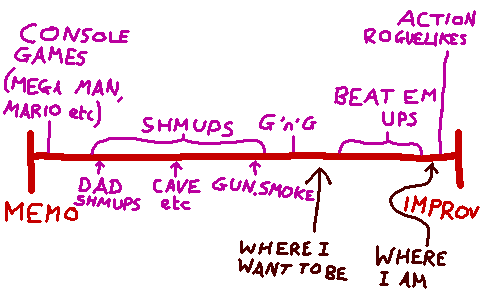
please enjoy this diagram from today's gamedev stream. it's the memorization-improvisation scale for action games! in reality it's more accurate to think of memo and improv as two separate axes instead of opposite ends of the same axis, but this diagram is good enough for me.
i was talking about how action games without enough improv can feel stale once you've memorized them, whereas action games without enough memo (like the current version of the game i'm working on now) can start to feel repetitive and hard to learn, because it's much easier for a new player to notice and memorize a static setpiece than it is for them to understand and work on a complex nuanced skill like beat em up crowd control or shoot em up screen control. no wonder a lot of beginner players tend to view beat em ups as repetitive.
so as much as i dislike memo-heavy console-style action games that don't offer much in terms of improv or fundamentals, adding a few memorizable/routable aspects to a game really does help to inject some variety and give players some easy short-term goals to achieve while they passively soak up their fuzzy fundamental skill knowledge. i'm looking forward to punctuating my game's open-ended improv rooms with a few predictable and exploitable setpieces and seeing how much of a difference it makes!
(After this was originally posted on cohost, shooting game designer Boghog replied with more useful design insights on memo elements in improv-heavy arcade games here. It's absolutely worth a read!)